

Limitations of External Validation
“To be yourself in a world that is constantly trying to make you something else is the greatest accomplishment.”
-Ralph Waldo Emerson
External validation gets a bad rap and for good reason. One can’t be authentic while constantly concerned with the judgements of others.
Ancestrally, acceptance in the tribe was essential. External invalidation led to death.
Contribute or be cast away.
Fit in or get out.
Execute your role or risk extinction.
Ironically, the extreme constraints placed upon our ancestors provided a daily purpose - to make a productive impact on your community.
Supporting the tribe in an effort to collectively provide the daily needs of water, food, shelter, and security for all led to belonging, self-esteem, and self-actualization.
Maslow’s hierarchy of needs was fulfilled from the bottom up.
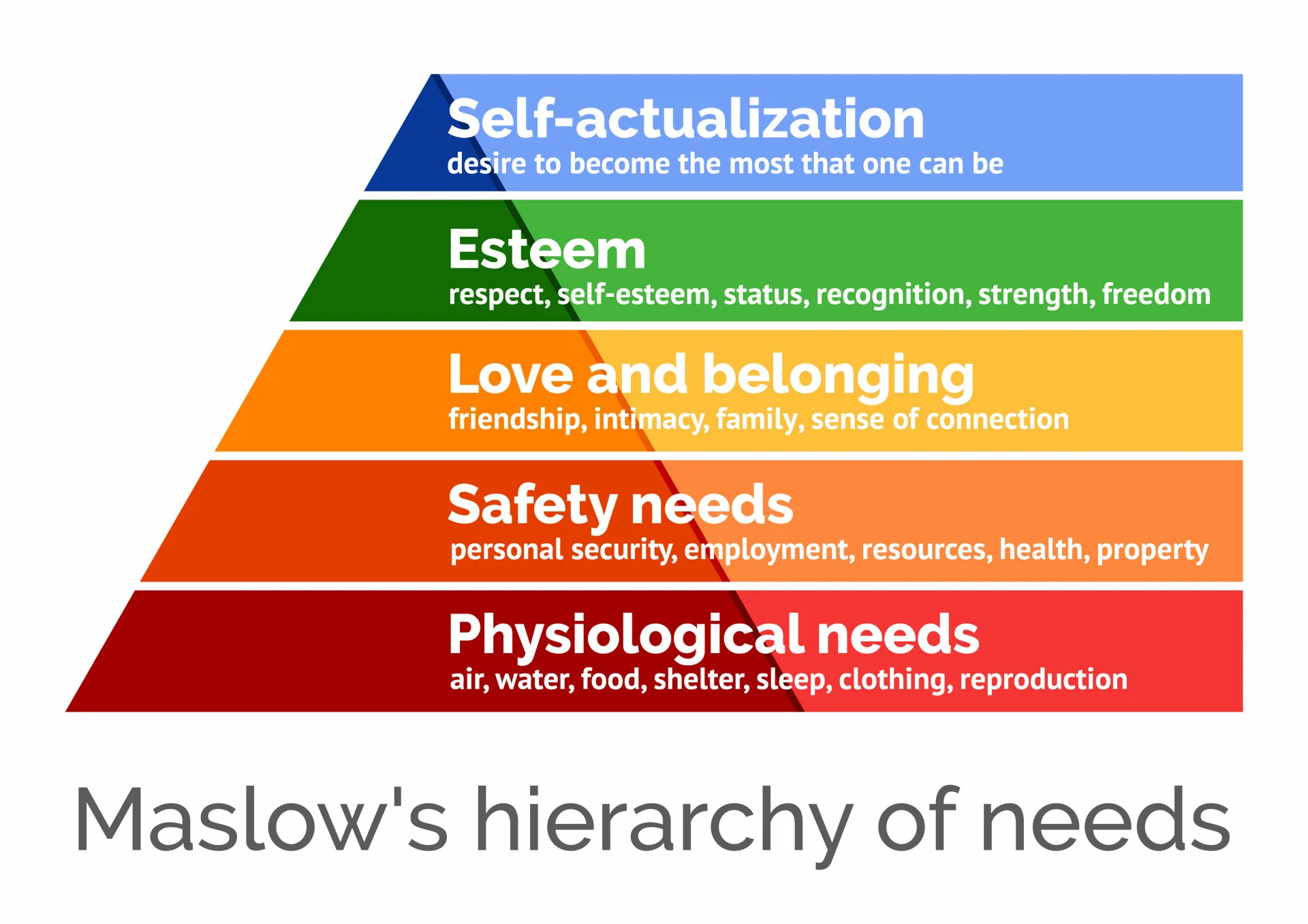
Civilization has provided most with the comforts of having our basic needs readily accessible. The mission of effectively providing for ourselves and communities has changed. For many, the challenge is now moderation of food, drinking water rather than soda or alcohol, getting out of the established shelter, and engaging in risk-worthy activities.
We no longer have to struggle to survive. Life can be lived passively.
With the foundation of Maslow’s hierarchy of needs being accessible from the comforts of our couches, we now struggle with perceptions of safety and a sense of belonging.
Physically, we’ve never been safer compared to our ancestors. Psychologically, we’ve never had the simultaneous luxury of physical safety combined with access to worldwide reasons to feel unsafe.
Rumination rules the roost.
I can give 100 realistic possibilities of your life ending by the time you finish reading this post.
I can also give one to help you reorient - none of them are in your control.
Endlessly ponder the uncertain, the unfair, and the uncontrollable to needlessly suffer.
Your perspective will always influence your reality as long as you’re lucky enough to be alive.
Watch the news, search the web, read the comments, or speak to those who concern themselves with all that is wrong with the world, however, and you’ll find yourself stuck in a psychologically unsafe loop.
Worse yet, we have countless systems designed to provide psychological safety through the guise of certainty and absolutes. Ideologies and algorithms attempt to short circuit our evolutionary biology to provide a sense of belonging amid uncertain safety in this complex world. Align with this political philosophy or believe this interpretation of an old text or risk not being accepted.
“Care about what other people think and you will always be their prisoner”
-Lao Tzu
In the modern world, people are more prone to imitating whatever is reportedly correct of the groups they want to belong in rather than risk perceptual judgement of being unsure or honest.
Why would one listen to the opinions of people they wouldn’t go to for advice?
There is no good answer to that question other than we are wired to fear external invalidation.
Culturally, we see the impacts of misplaced values that capitalize on our desire to belong: Social engagement metrics determine worth. Fashion and filters take precedence over character and skills. Emotion is promoted more than reason. Labels are applied instead of recognizing nuance. Identity is outsourced rather than seeking authenticity. Project judgments on others instead of reflecting on your own worth. Psychological safety is the goal as opposed to moral and spiritual integrity.
Seek external validation from all rather than risk invalidation from a few.
As an adult, constantly seeking acceptance is a slippery slope. The world and each person who inhabits it is complex. Seeking approval from the masses will only limit your capacity and fulfillment. We are the only ones who can truly gauge if our actions are consistently in alignment with our values.
“You will deserve respect from everyone if you will start by respecting yourself.”
-Musonius Rufus
Internal validation drives confidence, self-esteem, and resilience.
Extrinsic motivation leads to internal fragility.
We generally know the risk of seeking external validation, however, how does one cultivate internal validation in the developed, multi-tribal world?
We are fortunate for this dilemma. As with many modern problems, we can lean on ancient wisdom for solutions.
Productively Seeking External Validation
“If, at some point in your life, you should come across anything better than justice, prudence, self-control, courage—than a mind satisfied that it has succeeded in enabling you to act rationally, and satisfied to accept what’s beyond its control—if you find anything better than that, embrace it without reservations—it must be an extraordinary thing indeed—and enjoy it to the full.”
-Marcus Aurelius
The virtues of wisdom, discipline, courage, and justice are components of all philosophies, both religious and secular. They provide an operating system to assess your actions ensuring they’re your best attempt at being virtuous. It’s extremely difficult to assuredly assess virtue in anyone else which is why virtue is best when used as a self-orientating framework. They provide your How.
Core values, on the other hand, provide your Why. Whether it’s family, service, integrity, resilience, or self-improvement, core values offer the opportunity to lay the foundation for your authentic self. There are no inherently “correct” values to hold, however, it’s beneficial to keep them to principles rather than outcomes. Tying values to desirable results places them outside of your control. It also encourages projection rather than reflection. Control what you can - your impressions and subsequent actions. Only you possess the ability to verify the How and Why alignment in a given action.
Cultivation of values and application of virtue, however, takes time. Values also constantly evolve based on changes in life circumstance. Support is essential for individual success in all endeavors.
Seeking external validation to ensure your efforts are properly aimed and impacting your target populations is essential.
Trust yourself but validate with others.
Subjectively and objectively measure what matters.
There are various types of people in this world where validation can enhance fulfillment and guide continued progress such as loved ones, peers, mentors, coaches, supervisors, and subordinates. I’d recommend trying to find at least one of each. Regardless of type of person, ensuring they’re credible sources who you respect and trust is imperative.
Knowing who to go to and how to approach them is imperative when seeking validation. Tremendous value can be obtained when leveraging outside inputs with a healthy perspective.
Much like our ancestors, we are benefited by external validation assuming it’s coming from those who matter most to our cause.
Here are a few valuable sources and methods to seek validation from those we deem worthy.
Mission Statements
“Everyone has his own specific vocation or mission in life; everyone must carry out a concrete assignment that demands fulfillment. Therein he cannot be replaced, nor can his life be repeated, thus, everyone’s task is unique as his specific opportunity to implement it.”
-Victor Frankl
Missions statements provide the orientation of your efforts at scale - a North Star that illuminates your intention in life.
My personal mission statement is: I am committed to being a virtuously resilient father, husband, and man.
My family’s mission statement is: Our family is committed to connection, resilience, and trust.
You can anchor to a well-defined mission statement in any circumstance. Set your standard and then use it as a measuring stick for every subsequent action.
Core Values Check
“When the standards have been set, things are tested and weighed. And the work of philosophy is just this, to examine and uphold the standards, but the work of a truly good person is in the using those standards when they know them.”
-Epictetus
Establishing and prioritizing your core values is an ongoing and difficult task. Reflecting on whether or not your actions are currently in alignment with your unique values is even harder yet. Enhance this beneficial challenge by involving those impacted by the values.
If my number one value is family, I’d be wise to consistently check in with my wife and children to ensure my actions are either explained and/or evaluated from their lens.
Values provide our Why. They’re the meaning behind our actions. Meaning well doesn’t matter if the intended actions aren’t landing.
Understanding and aligning your core values with your respective people enhances desired results of your intentions.
Setting Expectations
“Without a ruler to do it against, you can’t make crooked straight.”
-Seneca
Life circumstance ebbs and flows. The demands and phases of life are constantly changing requiring endless reorientation of your efforts in order to deliver on your priorities.
In order to inspect what is expected, expectations must be regularly communicated.
Short, mid, and long term goal setting provides milestones that can be referenced when creating and managing expectations.
You’re never going to find complete balance in life. When work pulls you away from home or your personal life needs attention, revisit and update established expectations to determine solutions within your collective goals.
Setting and collectively reflecting on expectations ensures you’re continuously supporting your respective mission.
Constructive Feedback / Areas of Opportunity
“It takes humility to seek feedback. It takes wisdom to understand it, analyze it and appropriately act on it.”
-Steven Covey
Feedback is a signal. A pattern of feedback is a call to action.
Create internal and external feedback loops for constant evaluation and intervention when needed.
Seek constructive feedback from those you serve. Allow yourself to be curious, rather than defensive, in investigating opportunities to execute your respective mission.
Mission statements, core values checks, and expectation updates are all tools that can be used to effectively receive and reflect on constructive feedback.
Absorb these concepts and then apply them in your own unique ways to derive their benefit.
Summary
“For the meaning of life differs from man to man, from day to day and from hour to hour. What matters, therefore, is not the meaning of life in general but rather the specific meaning of a person’s life at a given moment.”
-Victor Frankl
There will always be areas of opportunity in your life. Continuous improvement is possible in a variety of ways.
Use established support systems or search for new ones to validate your progress.
We stand on the shoulders of giants while getting the chance to grow developing giants.
Cultivate your credible networks.
Find respected and trusted sources of knowledge.
We are ancestrally wired to seek belonging. Utilize effective methods with worthy people to seek external validation so you can continue making an impact where it matters most.
Humans are better known as Homo Socialis. We aren't individually intelligent but socially so and as such, we need external connection and that connection is validation. While we can't get lost in the idea of emeshment, where we become NPCs to others, we also can't ignore it. I think the loss of balance there results in what I'd call narcasisitic NPCs and is manifest in the explosion of cluster B tendencies.
Excellent read. Many things to think about to add to one's everyday existence to lead lead a more present and productive life❤️